Showing posts with label sushi knife. Show all posts

Wednesday, October 8, 2014

Why Authentic Japanese Kitchen Knives Make Ideal Christmas Gifts


           The Christmas season is just around the corner, and soon everyone will be busy with gift-giving and merrymaking. Why not try to give the most unique Christmas  presents for one’s loved ones and friends?  A unique but ideal Christmas gift would be to give away authentic Japanese kitchen knives to one’s loved ones and acquaintances.  Authentic Japanese kitchen knives are truly unique as these are gifts that literally can last a lifetime.  One’s friends and relatives who are very fond of cooking not necessarily Japanese cuisine, but all kinds of dishes and cuisine will find the gift of an authentic Japanese kitchen knife truly exciting.
           
            An authentic Japanese kitchen knife is most useful because the knife is able to aid in the preparation of the dish such that the ingredients’ flavors are properly preserved. The use of other knives which are not as sharp as authentic Japanese kitchen knives may result in cutting the food improperly, releasing juices and other liquids vital to the preservation of the dish’s final flavor. Authentic Japanese kitchen knives are thus important to the taste of the dish, and therefore to the satisfaction of everyone at the dining table, partaking of the dish.

            An authentic Japanese kitchen knife as a Christmas gift will certainly delight the recipient to no end. These Japanese kitchen knives are gifts that will have great utility for any man or woman who loves working in the kitchen and preparing meals for friends and family. Authentic Japanese kitchen knives are ultra-sharp, precise and yet they are also very easy to clean. They do not need too much maintenance in terms of sharpening and cleaning. A non-chemical cleaning agent will work very well with these Japanese kitchen knives, and one must simply remember that these Japanese kitchen knives have to be cleaned immediately after cutting a citrus fruit or if it is soaked in a chemical solution. The preservation of the Japanese kitchen knife against chemicals is a must.

            Authentic Japanese kitchen knives are unique not only because of their contribution to food flavor and easy maintenance, they are ideal Christmas gifts because they can already be considered as exquisite works of art. One can consider these Japanese kitchen knives as special art pieces carefully handcrafted and prepared.  There are others who even dare not use their authentic Japanese kitchen knives because they feel that these are too beautiful to use in their very own kitchens.

            Thus, authentic Japanese kitchen knives are ideal Christmas gifts because they are the best to use in cooking and food preparation. They are also easy to maintain, and finally, they are unique works of art that give their buyers value for money, and will make any recipient of these authentic Japanese kitchen knives extremely delighted and happy.


Buy that ideal Christmas gift here with 10% DISCOUNT!

Saturday, September 27, 2014

Hand Forged Knives: Your Durable Cutting Tools


Hand forged knives nowadays are rarely used most especially in places where the use of modern technology is prevalent. Forging, according to Wikipedia, is a manufacturing process involving the shaping of metal using localized compressive forces. It is known to be one of the oldest methods used in knife making.


In the early traditions, forging was executed using hammer and anvil by a smith. Though when water pressure and working of iron for knife making was introduced during the 12th century, they became obsolete. Today, we have industrial forging where hammers or presses powered by compressed air, electricity, and hydraulics are being used.


Difference between Hand Forged Knives and Machine Processed Knives


Hand forged knives are stronger as compared to knives that are made using machines. During the forging process, the inside particle of the steel gets deformed as it follows a shape. Because of this, the particle is spread out in uniform fashion throughout the blade giving it enhanced strength qualities.


Here are simple steps on how to make your very own hand forged knife:


See it here: "How to make your very own hand forged knife"

Wednesday, September 24, 2014

Maki-e Art: Sophisticated As a Sushi Knife

Takeshi Saji Sushi Knife

The art of Maki-e-making is as sophisticated as a sushi knife. Maki-e art originated from Japan and is now considered as part of the Japanese culture. The inclusion of a Maki-e art in a Japanese Sushi Knife makes the knife more valuable and worth keeping. Some Japanese knives collectors don’t use these knives with Maki-e arts the way they are intended to be used but merely put them on display.


History of Sushi Knives

 
The rich history of sushi knife-making dates back to the 14th century when most of the techniques used can go back as far as 1000 years ago. When carrying of Samurai swords became illegal in the 19th century, most craftsmen making Samurai swords turned into crafting sushi knives as their business.


Since then, hundreds of years of accrued understanding and experience in sushi knife-making have been handed down from masters to students.


Razor sharp sushi as well as sahimi knives are hand-made for a particular job and there are particular directions to hold and preserve them. Many knives are made up of high-grade carbon steel. High-grade carbon steel is not stainless so sushi knives made from this type of steel can rust easily. Though the good thing about sushi knives is that they are easy to sharpen.


This kinds of knives have single-beveled edge meaning only one side holds the cutting edge while the other side stays flat. The flat edge is there so that foods don’t stick to the knife.
 

Most sushi knives are made right-handed since many people believe that it is easier to cut fish using the right hand. Generally, left handed knives are made to order and cost a lot more than the right handed knives.


They either made true forged (Honyaki) or mist (Kasumi). Honyaki is made from a high-grade single steel while Kasumi is made from two types of steels which are hard iron and softer high carbon.


Essential Sushi Knives:

  • Yanagi-ba - Yanagi-ba is what they call the typical knife for cutting sushi rolls.
  • Deba - Ideal for cutting through bones and fish cartilage.
  • USuba - Best for fine cuts and peeling.
  • Santoku - Known as the “three virtues” which is ideal for fish, meat, and vegetables.
 
If you are looking for this type of kitchen knife decorated with a beautiful art, see Yanagiba Sushi Knife with Makie-e Art.

Friday, August 8, 2014

Takayuki Iwai knife Best for Cutting Sashimi

All About Sashimi

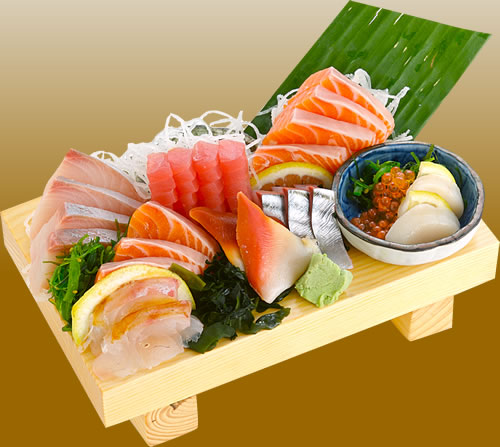
Sashimi image via www.sashimi.se

Sashimi, which means “sliced food” is probably one, if not, the most famed dish among Japanese cuisine. Delicately and thinly sliced, Sashimi is the best way to serve uncooked fish. Most Japanese people, in a formal meal agree that before eating other foods, sashimi should be eaten first. This is observed especially in a formal meal. But it can be considered as main course when miso soup and rice in separate bowls are presented with it. 

This would probably be a surprise but if you think fish is the only food that can be eaten uncooked as sashimi, think again. There are also other kinds of red meats that can be served as sashimi like beef, deer, and horse. There are some people who think that sashimi and sushi are the same but they are not. Sushi has sweet rice-wine vinegar rice while sashimi does not. 

How to Eat Your Sashimi


 In eating your sashimi, soy sauce can add flavor to it. Usually, restaurants have a small dish that you can use to pour some soy sauce and dip a piece of sashimi before eating. Contrary to how many people eat their sashimi by mixing wasabi (ground ginger) with soy sauce, the proper way is to dab the wasabi on top a piece of sashimi. To get that minty taste, you can eat the daikon or shiso vegetables that are normally used as garnishing to your sashimi. 

Health Benefits of Sashimi


Our body needs protein for muscle development and fish is a healthy source of it. The kind of protein we can get from sashimi is low in fat which is ideal for weight watchers. 

Sashimi is rich in essential fatty acid, omega-3. This kind of fatty acid helps maintain good cardiovascular health by lowering down cholesterol levels. Sashimi also has vitamins B6 and B12, phosphorous, magnesium, and niacin.

In Japan, they have this saying, “Kasshu hoju” (cooking is second to cutting). Sashimi is prepared with knives.


Takayuki Iwai Aogami Steel
At Japanny online store, we have a wide array of authentic Japanese knives for you to choose from. For sashimi preparation, we boast of our Takayuki Iwai Aogami Steel No. 2 Fumon Series Sashimi Knife. The Fumon Series is made by Takayuki Iwai. They do all the work by hands to ensure perfect control in making their knives. They care about quality that they do not mass produce. For Takayuki Iwai knife, it is quality over numbers! Japanny is the sole distributor of these impressive knives outside Japan.

Thursday, August 7, 2014

Advice for buying Japanese Knives


When it comes to art of metalworking, Japan has an old and grand tradition on it. Like Solingen in Germany, centers for knife making are found all over the country. Knife makers differ in the technology they use and the quality of their knives. 

Knives that are functional and hand-made can be considered a form of art. The basic steps in producing a knife are prepared by the knife maker himself or they call smith. The quality of his knife is assured by his reputation and name. Usually, knives with the highest quality and costly ones come from smiths who have extensive years of training and sensible practice behind them. Materials used and the name of the smiths dictate the price of the knife.

He is a traditional forge-smith and craftsman. He was born in 1948 at Takefu City of Fukui prefecture. It is a place with 700 years history of Echizen Uchi-Hamono or better known as Hammer Forged Knives. 

Takeshi Saji got his training in basic forging process and technique for 3 years at a local blacksmith teaching school. At age 18, he got engaged in knife making under the direction of his father and master, Harukichi Saji, who was a second generation. At age 30, after perfecting the skills needed to craft beautiful knives, Takeshi Saji was finally allowed to make his own. He got the certification “Traditional Craftsmen” from M.I.T.I in 1992. 

Takeshi Saji has a vast wealth of experience in knife making and after 45 years of being in the industry, with his bright ideas and designs, his traditional forged custom knives are now popular in Japan thus giving him the title one of the most well-known forge-craftsmen from Takefu City.

Takeshi Saji’s selections are gradually growing and each custom knife has distinctive style and personality. 

Takeshi Saji

Advice for buying Japanese Knives 


When you look for a Japanese knife, you will notice a huge range of prices which can be hard to understand. But as a rule of thumb, Japanese knives are not more expensive than European knives considering the same quality.  A handmade knife usually costs quite a bit taking into consideration the many hours spent in doing it by a highly-skilled hand. At japanny.com, we believe our knives are fairly priced. 

Decorative touches, like Damascus steel blades on some Japanese knives do not affect the knife’s cutting ability but demand higher price. These knives are attractive and guarantee satisfaction. At the core of all Japanese knife blades is high-carbon steel which makes the knife a cut above the rest.

What is important is you do not pay for a sub-standard knife with a high price or fall for an ad campaign of a company and buy their knife that does not cut well.

Identify the type of knife you need. For every kind, japanny.com has an array of the finest knives that are fairly priced. If you are unsure what you need, get an all-purpose knife that has three-layer blade. With this kind, you will find out and learn the qualities of Japanese knives. Later on, you might want to try other types like deba-bocho (to fillet fish), nakiro-bocho (to cut vegetables), tako-biki hocho (to slice fish) or the perfect knife for the kind of food you want to prepare.