Monday, July 18, 2016

How can I prevent my knife getting rusty after each use?

I sometimes get question from customers that the knife starts get rusty right after using them and wondering if it is normal to getting rusty so easily.
Answer for the question is that the traditional Japanese carbon steels such as Blue Steel and White Steel are really easy getting to rusty although cutting performance is one of the best.

You can prevent getting the knife rusty by wiping with it every time you use it. After you finishing day work then you may use any type of oil on the kitchen paper, and wipe knife gently. I know it is troublesome to do so but this is a standard way to get rust from your knife.


If you are type of the person who are not worrying about getting rusty I suggest to get like VG10, R2 ,Silver No 3,  or any stainless resistance steel, so that you don’t worry about it.

                                          Sakai Takayuki Sekiryu Blue Steel No.2 Japanese Sword Style
                                          Japanese Sushi Knife -270mm

                                         Shigeki Tanaka Blue Steel 17 Layer Damascus Gyuto Japanese Chef
                                         Knife  210mm

                                          Sakai Takayuki VG10 33 Layer Damascus Japanese Nakiri Chef
                                          Knife 160mm

                                         Kanetsune VG10 17 Layer Damascus Japanese Sushi Sashimi 
                                         Knife -210mm

Friday, July 15, 2016

Sukenari announced Sukenari Knives R2/SG2 New Series

R2/SG2 is Takefu Special Steel Company’s steel and HRC is 65 – 64. Blade has razor sharp cutting edge and good retention Sukenari is known for ZDP189 and making knives for Hitachi Steel Company. However, ZDP189 is priced very high and it is not easy to purchase by everyone. Instead, RE/SG series is reasonable despite of it quality. There are 2 types. One is 3 Layer model, and the other is Damascus Mirror Finish. It looks stunning and blade quality is one of the top.


Tuesday, June 28, 2016

[Takefu’s Legendary Blacksmith: Anryu katsushige]


[Takefu’s Legendary Blacksmith: Anryu katsushige]


Master Anryu was awarded for the Traditional Craftsmanship Distinguished Service last autumn. He has been manufacturing forged cutlery for over 50 years, and one of real legend. Since his work is very thorough and with care, it is not possible to create a large amount but each knife is a top end.
You may feel Anryu san’s soul and thoroughness from his knives. One of most popular knives is ’Blue Super Clad Series’ and often sold out in our shop, too. Please take this opportunity to have a look his knives.

Ketsushige Anryu 3 Layer Cladding Blue Super Core Hammerd Japanese Chef's Gyuto Knife 240mm


Katsushige Anryu 3 Layer Cladding Blue Super Core Petty Japanese Chef Knife 75mm


Katsushige Anryu 3 Layer Cladding Blue Super Core Hammerd Japanese Chef's Sujihiki Knife 270mm


Katsushige Anryu 3 Layer Cladding Blue Super Core Hammerd Japanese Chef's Nakiri Knife 165mm


Friday, June 17, 2016

Picking Right Sharpening Stones for your Japanese Chef Knives

Knife blade need to be sharpen by Sharping Stone. Frequency of sharpening as for Japanese professional chef is daily, however in basic, please sharpen when you feel that knife’s sharpness become dull. At least, we suggest to sharpen a knife once a month. 
Sharpening stones are consisting of 3 types 
rough stone, 220 grit or so, will remove a lot of material quickly. This is useful for repairing chips or setting a new bevel angle on a blade.

medium grit stone, typically 1000 to 1500, is usually the first stone you'll use if the knife is very dull, but not damaged. The finer grit removes enough material to restore the cutting edge, but not so much material that you'll grind the blade down quickly.

fine stone, typically 4000 grit, is used for polishing a cutting edge until it's very sharp. This is usually as fine as you'll want to polish a knife because it strikes a very good balance between sharp and durable.

We recommend two side sharpening stone as you can benefit two types of grit with one sharpening stone.

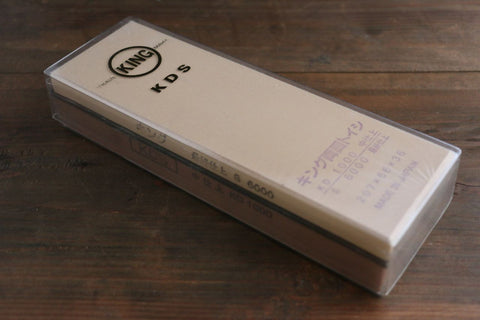
King Two Sided Sharpening Stone - #1000 & #6000
and
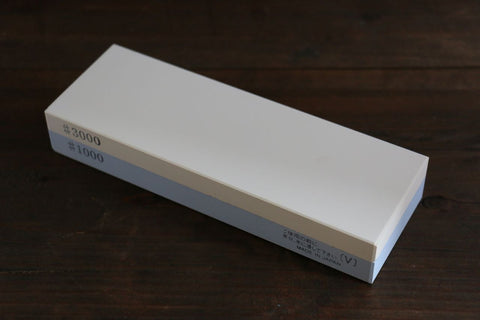
Suehiro Two Sided Sharpening Stone - #1000 & #3000
Refer below for details!

Monday, June 13, 2016

Recommendation of Japanese Chef Knife

Received the message saying ‘I want to buy one or a set of knives. But I want to know most precious knives not as price tag but its history and profession on knife making. What brands can you recommend to me?‘
When I recommend knives to customer, I always imagine about the user. How he wants to use, what is his need, preference, style, shape, etc.  
We often recommend Sakai Takayuki knives since they are reasonable and popular. In this case, however, I recommend Yu Kurosaki knives as customer mentioned its history and profession.

You can see his knife collection here;
http://www.japanny.com/collections/yu-kurosaki

Yu Kurosaki is a young talented craftsman who follows the traditional knife making of Takefu region which is well known for its professional knife making history in Japan. He is very ambitious for making unique knives and spread the name of Takefu to other countries. We value his passion and profession. Needless to say, quality of his knives are superb. Comparing to famous brand knives, his knives are reasonable for its quality.


Yu Kurosaki R2/SG2 steel Hammered Japanese Chef’s Nakiri Knife 180mm


Yu Kurosaki R2SG2 steel Hammered Japanese Chef’s Gyuto Knife 240mm


Yu Kurosaki R2SG2 steel Hammered Japanese Chef’s Sujihiki Knife 270mm

Friday, January 9, 2015

Exciting January!


The past year has been a tremendous one for us in terms of sales turnout and it was all because of your continued patronage to our authentic Japanese kitchen chef knives! It has taken us to a higher level of excitement to continue to serve you all!


To kick-off the year 2015, japanny.com is having its “Exciting January Promo”! This will entitle you to a FREE SHIPPING, anywhere in the world, with no minimum purchase required! You just have to type the code “FREESHIPPING” upon checkout. This promo runs from January 10 to January 24, 2015, PST.

Hurry! Shop now at www.japanny.com!   

Sunday, December 14, 2014

Miyako - Authentic Japanese Chef Knife


The Authentic Japanese Chef Knife – Miyako line type is another line of knives in the line of excellent kitchen knives of Japanny.com. This lovely kitchen knife line is made almost to perfection in the tradition of Japanese swordmaking. For a time in the history of Japan, the carrying of swords was banned in the attempt to modernize the country. Swordmaking groups therefore began to turn their attention to the manufacture of kitchen knives and other cutting knives while swordmaking itself was put on hold back then. As the name implies, the knife is called “MIyako” because it is beautiful.

The Authentic Japanese Chef Knife – Miyako is a series line in the company’s list of products. What is common to all of these knives is that they are Damascus steel 33 layer knives. This means that made out of high carbon stain resistant alloy, and as the line is a series, there are many variants of this line. They all have double-edged blades and are made out of Damascus steel. Damascus steel is noted for being used in Middle Eastern swords, and just as in the authentic Japanese knife – Miyako line, there are unique and special patterns of banding and mottling that makes one think about flowing water. These blades are very tough, and do not shatter easily and can be sharpened to a very sharp and resilient blade edge. Legend has it from the ancient times that Damascus steel is sharp enough to cut hair that falls across the blade, and is also sharp enough to cut through rifle barrels.  Therefore one can be assured of the excellent and consistent quality of the blade when utilized even by a newbie cook in the kitchen. Precautions must be taken, such as avoiding cutting frozen items such as frozen bones or other products. If one does this, then the blade may break or chip. The blade should be handwashed and towel-dried.  A sharpening stone may be used in order to sharpen the authentic Japanese knife – Miyako.

The Authentic Japanese Chef Knife – Miyako line is truly one that any cook or owner can be truly of. It will be recalled that sharp blades and knives are able to maintain the flavor of the food that they are cutting or slicing. Thus, the flavor of meats is maintained when the line of authentic Japanese Kitchen knives - Miyako is used, such that the dish retains all the original and fresh flavor of the meats when they are cooked. Likewise, the delicious and juicy flavors of fruit remain when they are cut using these knives, such that one can taste the freshness of the fruit while being able to absorb and digest all the natural nutrients that the fruit has to offer. The Authentic Japanese Kitchen Knife- Miyako line will not disappoint its user, whether he be a newbie in the kitchen or a professional and experienced cook. One can consider this line of knives as a most important tool that will enable him to perform his role as a cook to the best of his ability, with all the dishes he prepares as the most flavorful and delicious as well.  All rookie and experienced cooks will appreciate having an Authentic Japanese Kitchen Knife – Miyako in their collection of knives. They will be in possession of an excellent cutting, slicing or paring tool that they can depend on all of the time.


Thursday, December 11, 2014

Get your authentic Japanese knife, CHEAPER & FASTER!


To make this holiday season merrier, we, at Japanny.com are giving you 10% discount PLUS we will give your Standard Shipping a FREE upgrade to Expedited Shipping! This means, you can buy our knives at cheaper prices and you'll get them FASTER and in a more SECURED manner! Just use the code "X10OFF" upon checkout! Hurry! Shop now at www.japanny.com

Wednesday, November 19, 2014

Iseya Japanese Kitchen Knife


The Iseya JapaneseKitchen Knife is what one would call a petty utility knife. It is quite shorter than the usual Japanese Kitchen Knife, but is very helpful in the kitchen.  This knife is usually used for a number of food preparation activities, ranging from paring to cutting to filleting. The utility knife is also an excellent carving tool for the many food decorations that make presentation unique and memorable. The Iseya Japanese Kitchen Knife is one such petty utility knife that will make life so much easier for any cook, whether he is a professional or not. The practicality of having a petty utility knife will help make the cook more skilled in the tasks of paring, cutting, chopping, carving, filleting, and in any other knife task that is necessary in order to produce the highest quality dish that can be prepared.

            This petty utility knife is indeed very special. The Iseya Japanese Kitchen Knife is one that is patiently and lovingly made from several layers of forged Damascus steel. In fact, this knife alone has 33 layers of Damascus steel, a feat that is truly difficult to replicate. Thus the Iseya Japanese Kitchen Knife has a very strong blade that can endure many difficult kitchen knife tasks. The sharpness and edge retention of the knife is impeccable and superior as compared to other kitchen knives of the same kind. Damascus steel is known as one of the best and most superior steels that can be used for knife manufacturing. This type of steel has long been used in the Middle East to produce the best swords that have been utilized since the ancient times. The blades created from Damascus steel are reputed to be one of the best in terms of being tough and being resistant to breaking or shattering. In addition to this, Damascus steel is known for its characteristic “organic” pattern, hence making the knives made from this steel among the most beautiful and elegant knives ever made.


            With all these characteristics present in the Iseya Japanese Kitchen Knife, certainly this knife will be a most essential tool in any cook’s kitchen.  Aside from possessing the most efficient knife made out of the best Damascus steel, the Iseya Japanese kitchen knife is also a work of art that is unique. Each cook who possesses this knife will adore its workmanship and organic beauty. The various tasks of paring, cutting, chopping, carving, filleting and others will be made easier because of this knife. Of course the cook or user must not forget to avoid using this knife when attempting to chop frozen items or bones. The blade may chip or crack if this is done. Maintenance is easy as only warm water is necessary for hand washing the blade, and drying with use of a towel is all that is necessary. The Japanese Iseya Kitchen Knife will be another jewel in the kitchen for any cook, whether he is a rookie or an expert.

Friday, November 7, 2014

The Ichiban VG10 19 Layer Damascus Santoku Japanese Knife


The Ichiban VG10 19 Layer Damascus Santoku Japanese Knife is a work of art but a fully functioning tool that any kitchen worker will appreciate.  It is a Santoku all purpose kitchen knife, that is made up of the VG 10 Steel Type, and has a double-edged blade. The total blade length is 180 mm. Thus this beautiful Ichiban VG 10 19 Layer Damascus Santoku Japanese Knife is one that any kitchen expert will recognize as a beautiful tool that will be able to function beautifully as well in the kitchen. Any experienced and professional chef will recognize that the quality of this knife is well above that of any sub-standard kitchen knife, as the materials used for this knife are of the most premium quality and class. The company responsible for the manufacture and marketing of this knife, the Japanny Company, takes pride in this excellent product.  This lovely kitchen knife has been hammered by hand  to perfection such that its blade is the strongest. This Ichiban VG 10 19 Layer Damascus Santoku Japanese Knife also has superior edge retention, sharpness and is strain resistant because of the VG 10 Steel that has been utilized therein.

            As the name implies the Santoku knife is double-edged. This knife can therefore be honed and sharpened on both edges, but the cutting edges are uniquely angled so that the cuts that are made with this knife are the cleanest and the most precise cuts indeed. In many restaurants today, even if the cuisine is not Japanese, some chefs make use of Japanese kitchen knives because of the precision cutting that is achieved with their use. Among the chefs in the restaurant industry, Japanese kitchen knives are known to be the sharpest. This is also due to the manufacturing technique of “layering”, which means that the steels are layered along the cutting edge, hence adding to their durability as well.


            However, Japanese kitchen knives are indeed reflective of Japanese cuisine, and the Ichiban VG 10 19 Layer Damascus Santoku Japanese Knife is one such tool that can help enhance the flavor of the Japanese dishes that are prepared with it. The craftsmanship of this knife is likewise impeccable, with the parts of the knife held together firmly in place, thus allowing the chef greater range of movement during its use.  The Santoku knife is known to be an excellent chopper and slicer not only of meats, poultry and fish, but also of vegetables and fruits. Thus it is known as an all-around kitchen knife. In the end, the Ichiban VG10 19 Layer Damascus Santoku Japanese Knife is not only a work of art, but it is a helpful tool that can produce the most delicious and savory Japanese (and other) cuisine. Chefs will find it as an indispensable kitchen tool that they will not be able to work well without. Housewives and other homemakers will likewise find that their life will become easier with this excellent and high-quality knife.

Saturday, November 1, 2014

The Tojiro DP Series Japanese Kitchen Knives


One will recall that authentic Japanese kitchen knives are among the best tools of a chef. This is because the precision cutting rendered by authentic Japanese kitchen knives help provide the food with the best flavor possible.  An exciting brand of authentic Japanese kitchen knives is the Tojiro DP Series Japanese kitchen knives. The Tojiro factory can be found in the Tsubane-Sanjo district, which used to be one of the provincial areas where the best Japanese swords were produced. While the initial techniques were already of high standards, the succeeding generations of swordmakers and knife makers improved on these techniques with the aid of the best technology possible for the manufacture of authentic Japanese kitchen knives. The predecessor knives of the Tojiro DP Series Japanese kitchen knives were given as gifts to the Shogun, who appreciated the excellent quality of the same.  Tojiro DP authentic Japanese kitchen knives are manufactured with care by the Fujitora Industry Company Limited. The company has retained all the techniques and processes handed down from the earlier years. While the process has been modernized, there still are techniques that may be considered cultural gems which are still utilized in the manufacture of these Tojiro DP Series Japanese kitchen knives.

            The operations of the Fujitora Industry Company Limited are centered on the word “sharpness”. The manufacture of the Tojiro DP Series Japanese Kitchen knives is based on this word as well. The high regard for traditional techniques, as well as the company’s never-ending quest to increase the level of quality of its authentic Japanese kitchen knives have resulted in the unique quality of the Tojiro DP Series Japanese kitchen knives. One specific Japanese kitchen knife is the Tojiro DP Cobalt Alloy Steel Series by 3 Layers. There are several models in this specific series. One may find the Japanese kitchen knife that is double-layered, or single-layered as well. All of the blades of the Tojiro DP Series Japanese kitchen knives have been manufactured under a strict quality control environment. These Japanese kitchen knives are very durable and ultra-resistant to corrosion. The use of reinforced laminated material for the Tojiro DP Series Japanese kitchen knives means that eco-friendly materials were used, and that the feeling of the user is like one who is using a brand-new authentic Japanese kitchen knife always.  The Tojiro DP Series Japanese kitchen knives are the preferred tools of use of many chefs around the world.

            Finally, in the tradition of authentic Japanese kitchen knives, the Tojiro DP Series Japanese kitchen knives are also known for their aesthetic and art quality. The Japanese sense of beauty and the never-ending pursuit for perfection and total quality is reflected in the performance of this knife series.  Therefore, among all the authentic Japanese kitchen knives in the market, the Tojiro DP Series Japanese kitchen knives will always be among the top performers that are desired by many chefs, cooks and even by housewives around the world.


Thursday, October 9, 2014

A Very Useful Kitchen Tool - Japanese Petty Knife


There is no discussion when one says a petty knife is one of the most useful kitchen tools. Some people say that to be able to endure the kitchen, you need only a petty knife. This very useful cutting tool is the Japanese version of a paring knife. Typically, Japanese petty knives do not have bolster on the blade, thin, and are very light.   

Japanese petty knives are ideal for different vegetables, herbs, and fruits tasks such as peeling, paring, and carving. It can also be used for slicing and dicing jobs. 

Preparing fruits (for a quick snack) like oranges requires some knife skills since there is peeling and segmenting of the orange meat that needs to be done.

Here is the step by step procedure on how to prepare this zesty orange for snack:
       Cut-off both sides of the orange
       Have it sit on one cut side
       Using a Japanese petty knife, cut off the peel in strips, mindfully following the curve of the orange
       Cut the membranes on all sides to expose the orange meat
       Segment the orange

A Japanese petty knife can maneuver even the tight and delicate turns of any fruits. 

Although small in size, but the blade of a Japanese petty utility knife is razor sharp. You can expect the same sharpness and edge retention you can find from bigger knives in Japanese petty knives.    

As compared to its Western counterpart, the Japanese petty knives are lighter and sharper. Aside from that, Japanese blades have one side of the edge at a steeper angle giving the users the liberty to sharpen them at different angles. 

Just like any other traditional Japanese knives, the petty knife requires proper care and handling to serve its master for a long time. Never use your petty in cutting through frozen meats and bones. After every use, wipe it dry.  


If you are looking for a Japanese petty knife, please click here.  

Wednesday, October 8, 2014

Why Authentic Japanese Kitchen Knives Make Ideal Christmas Gifts


           The Christmas season is just around the corner, and soon everyone will be busy with gift-giving and merrymaking. Why not try to give the most unique Christmas  presents for one’s loved ones and friends?  A unique but ideal Christmas gift would be to give away authentic Japanese kitchen knives to one’s loved ones and acquaintances.  Authentic Japanese kitchen knives are truly unique as these are gifts that literally can last a lifetime.  One’s friends and relatives who are very fond of cooking not necessarily Japanese cuisine, but all kinds of dishes and cuisine will find the gift of an authentic Japanese kitchen knife truly exciting.
           
            An authentic Japanese kitchen knife is most useful because the knife is able to aid in the preparation of the dish such that the ingredients’ flavors are properly preserved. The use of other knives which are not as sharp as authentic Japanese kitchen knives may result in cutting the food improperly, releasing juices and other liquids vital to the preservation of the dish’s final flavor. Authentic Japanese kitchen knives are thus important to the taste of the dish, and therefore to the satisfaction of everyone at the dining table, partaking of the dish.

            An authentic Japanese kitchen knife as a Christmas gift will certainly delight the recipient to no end. These Japanese kitchen knives are gifts that will have great utility for any man or woman who loves working in the kitchen and preparing meals for friends and family. Authentic Japanese kitchen knives are ultra-sharp, precise and yet they are also very easy to clean. They do not need too much maintenance in terms of sharpening and cleaning. A non-chemical cleaning agent will work very well with these Japanese kitchen knives, and one must simply remember that these Japanese kitchen knives have to be cleaned immediately after cutting a citrus fruit or if it is soaked in a chemical solution. The preservation of the Japanese kitchen knife against chemicals is a must.

            Authentic Japanese kitchen knives are unique not only because of their contribution to food flavor and easy maintenance, they are ideal Christmas gifts because they can already be considered as exquisite works of art. One can consider these Japanese kitchen knives as special art pieces carefully handcrafted and prepared.  There are others who even dare not use their authentic Japanese kitchen knives because they feel that these are too beautiful to use in their very own kitchens.

            Thus, authentic Japanese kitchen knives are ideal Christmas gifts because they are the best to use in cooking and food preparation. They are also easy to maintain, and finally, they are unique works of art that give their buyers value for money, and will make any recipient of these authentic Japanese kitchen knives extremely delighted and happy.


Buy that ideal Christmas gift here with 10% DISCOUNT!

Saturday, October 4, 2014

The Importance of Sharpening Your Knife

What is the importance of sharpening one’s knife?  The very first reason why one should have a sharp kitchen knife at home is that owning a sharp kitchen knife is protection against jagged cuts during food preparation. A cut from a sharp kitchen knife is closed by the end of the day as against the cut of a dull kitchen knife – the wound is jagged and does not close easily. The second reason why kitchen knives should be sharp is that a sharp kitchen knife helps preserve the flavor of the dish one is cooking. Just look at the case wherein one is trying to chop an onion into fine slices. A dull knife presses out the juices of the onion onto the sliding surface, whereas a sharp kitchen knife will preserve the juices which are then incorporated into the dish that one is preparing.  In other words, a good sharp kitchen knife will definitely make one’s life a lot easier. It is easier to cut and slice food, and the food looks a lot prettier when sharp kitchen knives are used.

            Perhaps among the most precise and sharp kitchen knives used in preparing dishes are Japanese kitchen knives.  The Japanese kitchen knife itself is considered as an essential element in cooking and preparing dishes as this is thought to determine the taste of the dish itself.  In almost all cases, Japanese cooks own their own personal set of Japanese kitchen knives.  They are always concerned about the maintenance of these knives, making sure that these Japanese kitchen knives are well-sharpened and in peak form each time they are used. Some professional Japanese chefs even have several sets of Japanese kitchen knives as the knives are believed to need to rest so as to eliminate any flavors that may have stuck to the knives the previous day. Many Japanese professional chefs sharpen their own kitchen knives with the use of whetstones. These whetstones are often used to grind and sharpen the edges of the knives. Whetstones come in a wide variety of types and sizes, and may either be artificial or natural. Sharpening a Japanese kitchen knife is an exciting exercise wherein one needs to determine even the angle of sharpening while using the whetstone, as the angle of sharpening may ultimately determine the flavor of the dish being prepared.

            A very sharp Japanese kitchen knife that has been carefully sharpened over a whetstone results in food that is precisely cut, and the food is cut in precise shapes and sizes. One can simply imagine the precisely cut tuna sashimi, with its perfectly sharp edges that help preserve the delicious natural sea-flavor of the tuna. How would one delight in eating roughly-cut pieces of tuna sashimi? A sharp Japanese kitchen knife is truly an asset that one can be proud of, and it is thus considered as a tool in the production of wonderful gastronomic delights.


For authentic and high quality whetstones, please click here!

Saturday, September 27, 2014

Hand Forged Knives: Your Durable Cutting Tools


Hand forged knives nowadays are rarely used most especially in places where the use of modern technology is prevalent. Forging, according to Wikipedia, is a manufacturing process involving the shaping of metal using localized compressive forces. It is known to be one of the oldest methods used in knife making.


In the early traditions, forging was executed using hammer and anvil by a smith. Though when water pressure and working of iron for knife making was introduced during the 12th century, they became obsolete. Today, we have industrial forging where hammers or presses powered by compressed air, electricity, and hydraulics are being used.


Difference between Hand Forged Knives and Machine Processed Knives


Hand forged knives are stronger as compared to knives that are made using machines. During the forging process, the inside particle of the steel gets deformed as it follows a shape. Because of this, the particle is spread out in uniform fashion throughout the blade giving it enhanced strength qualities.


Here are simple steps on how to make your very own hand forged knife:


See it here: "How to make your very own hand forged knife"

Wednesday, September 24, 2014

Maki-e Art: Sophisticated As a Sushi Knife

Takeshi Saji Sushi Knife

The art of Maki-e-making is as sophisticated as a sushi knife. Maki-e art originated from Japan and is now considered as part of the Japanese culture. The inclusion of a Maki-e art in a Japanese Sushi Knife makes the knife more valuable and worth keeping. Some Japanese knives collectors don’t use these knives with Maki-e arts the way they are intended to be used but merely put them on display.


History of Sushi Knives

 
The rich history of sushi knife-making dates back to the 14th century when most of the techniques used can go back as far as 1000 years ago. When carrying of Samurai swords became illegal in the 19th century, most craftsmen making Samurai swords turned into crafting sushi knives as their business.


Since then, hundreds of years of accrued understanding and experience in sushi knife-making have been handed down from masters to students.


Razor sharp sushi as well as sahimi knives are hand-made for a particular job and there are particular directions to hold and preserve them. Many knives are made up of high-grade carbon steel. High-grade carbon steel is not stainless so sushi knives made from this type of steel can rust easily. Though the good thing about sushi knives is that they are easy to sharpen.


This kinds of knives have single-beveled edge meaning only one side holds the cutting edge while the other side stays flat. The flat edge is there so that foods don’t stick to the knife.
 

Most sushi knives are made right-handed since many people believe that it is easier to cut fish using the right hand. Generally, left handed knives are made to order and cost a lot more than the right handed knives.


They either made true forged (Honyaki) or mist (Kasumi). Honyaki is made from a high-grade single steel while Kasumi is made from two types of steels which are hard iron and softer high carbon.


Essential Sushi Knives:

  • Yanagi-ba - Yanagi-ba is what they call the typical knife for cutting sushi rolls.
  • Deba - Ideal for cutting through bones and fish cartilage.
  • USuba - Best for fine cuts and peeling.
  • Santoku - Known as the “three virtues” which is ideal for fish, meat, and vegetables.
 
If you are looking for this type of kitchen knife decorated with a beautiful art, see Yanagiba Sushi Knife with Makie-e Art.

Sunday, September 21, 2014

A Masterpiece: Sprinkled Picture of Art in a Japanese Gyuto Knife


“Sprinkled picture of art in a Japanese Gyuto knife - a masterpiece!” This is probably a layman would describe a knife with a Maki-e art. Maki-e, in Japan, literally means “sprinkled picture”. Applied by using a makizutsu or akebo brush, This is a kind of Japanese lacquer drizzled in gold and silver powder used as an adornment.


The History of Maki-e Making

This Japanese art started from Nara period (710 - 794 CE) while in the Heian period (974 - 1185), it was tailored in Buddhist altar fittings. In Muromachi period (1333 - 1573 CE), Maki-e arts were used to serve court peerage for stationery-making like inkstone cases. But it was not until the Edo period (1603 - 1868) that it bloomed. It was polished over time and became the elegant art that speaks of Japan. Then its reputation was accepted by royal families and armed chiefs to signify their authority.

Artists who want to learn this art usually go through several years of guidance to acquire skills and to eventually, become an experts. A variety of metal powders can be used to come up with different colors and surfaces like with copper, brass, lead, aluminum, platinum, pewter, together their alloys.

The very first lacquer master linked to this kind of arts was Koami Docho (1410 - 1478). He used markings from different Japanese painters in his arts. There are two major schools of lacquer making in the history of Japan and Koami together with another master, Igarashi Shinsai, were its prime movers.

One of the major methods being used in making this was Takamekie (or raised Maki-e). Conceptualized in the Muromachi period, the method of Takamekie includes raising up drawing patterns directly above the surface using a combination of lacquer, metal powder, and charcoal.

When putting a black lacquer without oil on the metal design as an additional coating, that method is called Maki-e Togidashi.

Their art truly represents the Japanese people love for beauty. It is an art that speaks deeply of their culture and somehow gives the world an understanding of the Japanese people in this age of time.

See more Japanese Gyuto Knife beautified with a Maki-e art,
click >> goo.gl/g6h7X1

Friday, September 19, 2014

Japanese Knives: Beautifully Sliced Sashimi With A Yanagi Knife


Yanagi-ba-bocho literally means “willow blade knife”. Some people, for a shorter term, call it Yanagi. Yanagi knife belongs to the sashimi hocho group of Japanese knives. The Yanagi knife originated from Kansai (Osaka) region.
 

In order for a slice of sashimi to be called perfect, when one looks at it at a microscopic view, the inside must be smooth looking and shiny. And that is usually the result when it was sliced using a Japanese Yanagi knife.


Here is a list that makes a Japanese Yanagi knife perfect for slicing sashimi:


** Length – This knife has a long blade so it can slice through a block of raw fish in just one pulling direction. When one cuts the fish in an irregular pattern, the cross section is going to be bad not only in appearance, but it will also cause the cell of the fish being cut destroyed. This has a direct effect on the taste of the fish.
 
** Thickness – It has a thin blade that creates less effort in slicing a fish. When there is even the slightest amount of force added in slicing, one is not slicing anymore, but instead, tearing the fish.
Scraped Back Face – some Japanese Yanagi knives have its back faces scraped out so that the sliced fish easily detaches itself from the blade.

 
** Single Ground – one thing that makes a knife excellent for slicing fish is that it has a single ground blade. A single ground blade, aside from it being easy to sharpen, gives more control to the user for slicing delicate objects, like in this case, raw fish.
 

In making a Japanese Yanagi knife, its hardness and toughness is modeled in the same way as a Japanese sword. It is made using a combination of hard and soft steels; the softer steel wraps around the inner harder steel. So, what can users expect from a Japanese Yanagi knife? Sharpness and durability for a long period of time.

For beautifully sliced sashimi, use this knife!

visit www.japanny.com