Showing posts with label Chef Knife. Show all posts

Saturday, November 1, 2014

The Tojiro DP Series Japanese Kitchen Knives


One will recall that authentic Japanese kitchen knives are among the best tools of a chef. This is because the precision cutting rendered by authentic Japanese kitchen knives help provide the food with the best flavor possible.  An exciting brand of authentic Japanese kitchen knives is the Tojiro DP Series Japanese kitchen knives. The Tojiro factory can be found in the Tsubane-Sanjo district, which used to be one of the provincial areas where the best Japanese swords were produced. While the initial techniques were already of high standards, the succeeding generations of swordmakers and knife makers improved on these techniques with the aid of the best technology possible for the manufacture of authentic Japanese kitchen knives. The predecessor knives of the Tojiro DP Series Japanese kitchen knives were given as gifts to the Shogun, who appreciated the excellent quality of the same.  Tojiro DP authentic Japanese kitchen knives are manufactured with care by the Fujitora Industry Company Limited. The company has retained all the techniques and processes handed down from the earlier years. While the process has been modernized, there still are techniques that may be considered cultural gems which are still utilized in the manufacture of these Tojiro DP Series Japanese kitchen knives.

            The operations of the Fujitora Industry Company Limited are centered on the word “sharpness”. The manufacture of the Tojiro DP Series Japanese Kitchen knives is based on this word as well. The high regard for traditional techniques, as well as the company’s never-ending quest to increase the level of quality of its authentic Japanese kitchen knives have resulted in the unique quality of the Tojiro DP Series Japanese kitchen knives. One specific Japanese kitchen knife is the Tojiro DP Cobalt Alloy Steel Series by 3 Layers. There are several models in this specific series. One may find the Japanese kitchen knife that is double-layered, or single-layered as well. All of the blades of the Tojiro DP Series Japanese kitchen knives have been manufactured under a strict quality control environment. These Japanese kitchen knives are very durable and ultra-resistant to corrosion. The use of reinforced laminated material for the Tojiro DP Series Japanese kitchen knives means that eco-friendly materials were used, and that the feeling of the user is like one who is using a brand-new authentic Japanese kitchen knife always.  The Tojiro DP Series Japanese kitchen knives are the preferred tools of use of many chefs around the world.

            Finally, in the tradition of authentic Japanese kitchen knives, the Tojiro DP Series Japanese kitchen knives are also known for their aesthetic and art quality. The Japanese sense of beauty and the never-ending pursuit for perfection and total quality is reflected in the performance of this knife series.  Therefore, among all the authentic Japanese kitchen knives in the market, the Tojiro DP Series Japanese kitchen knives will always be among the top performers that are desired by many chefs, cooks and even by housewives around the world.


Thursday, October 9, 2014

A Very Useful Kitchen Tool - Japanese Petty Knife


There is no discussion when one says a petty knife is one of the most useful kitchen tools. Some people say that to be able to endure the kitchen, you need only a petty knife. This very useful cutting tool is the Japanese version of a paring knife. Typically, Japanese petty knives do not have bolster on the blade, thin, and are very light.   

Japanese petty knives are ideal for different vegetables, herbs, and fruits tasks such as peeling, paring, and carving. It can also be used for slicing and dicing jobs. 

Preparing fruits (for a quick snack) like oranges requires some knife skills since there is peeling and segmenting of the orange meat that needs to be done.

Here is the step by step procedure on how to prepare this zesty orange for snack:
●       Cut-off both sides of the orange
●       Have it sit on one cut side
●       Using a Japanese petty knife, cut off the peel in strips, mindfully following the curve of the orange
●       Cut the membranes on all sides to expose the orange meat
●       Segment the orange

A Japanese petty knife can maneuver even the tight and delicate turns of any fruits. 

Although small in size, but the blade of a Japanese petty utility knife is razor sharp. You can expect the same sharpness and edge retention you can find from bigger knives in Japanese petty knives.    

As compared to its Western counterpart, the Japanese petty knives are lighter and sharper. Aside from that, Japanese blades have one side of the edge at a steeper angle giving the users the liberty to sharpen them at different angles. 

Just like any other traditional Japanese knives, the petty knife requires proper care and handling to serve its master for a long time. Never use your petty in cutting through frozen meats and bones. After every use, wipe it dry.  


If you are looking for a Japanese petty knife, please click here.  

Sunday, September 21, 2014

A Masterpiece: Sprinkled Picture of Art in a Japanese Gyuto Knife


“Sprinkled picture of art in a Japanese Gyuto knife - a masterpiece!” This is probably a layman would describe a knife with a Maki-e art. Maki-e, in Japan, literally means “sprinkled picture”. Applied by using a makizutsu or akebo brush, This is a kind of Japanese lacquer drizzled in gold and silver powder used as an adornment.


The History of Maki-e Making

This Japanese art started from Nara period (710 - 794 CE) while in the Heian period (974 - 1185), it was tailored in Buddhist altar fittings. In Muromachi period (1333 - 1573 CE), Maki-e arts were used to serve court peerage for stationery-making like inkstone cases. But it was not until the Edo period (1603 - 1868) that it bloomed. It was polished over time and became the elegant art that speaks of Japan. Then its reputation was accepted by royal families and armed chiefs to signify their authority.

Artists who want to learn this art usually go through several years of guidance to acquire skills and to eventually, become an experts. A variety of metal powders can be used to come up with different colors and surfaces like with copper, brass, lead, aluminum, platinum, pewter, together their alloys.

The very first lacquer master linked to this kind of arts was Koami Docho (1410 - 1478). He used markings from different Japanese painters in his arts. There are two major schools of lacquer making in the history of Japan and Koami together with another master, Igarashi Shinsai, were its prime movers.

One of the major methods being used in making this was Takamekie (or raised Maki-e). Conceptualized in the Muromachi period, the method of Takamekie includes raising up drawing patterns directly above the surface using a combination of lacquer, metal powder, and charcoal.

When putting a black lacquer without oil on the metal design as an additional coating, that method is called Maki-e Togidashi.

Their art truly represents the Japanese people love for beauty. It is an art that speaks deeply of their culture and somehow gives the world an understanding of the Japanese people in this age of time.

See more Japanese Gyuto Knife beautified with a Maki-e art,
click >> goo.gl/g6h7X1

Sunday, September 14, 2014

Superior Japanese Knives Made From ZDP 189 Steel


Damascus Gyuto Japanese Chef's Knife

The super steel material ZDP 189 from Hitachi used in knife production, has an extremely high carbon (3%) and chromium (20%) content making it expensive to manufacture. It is made using powdered metal technology.
 
The pure carbon content of ZDP 189 makes it one of the most edge retentive alloy in the knife industry. What makes the ZDP 189 steel remarkable is that it can be hardened up to RC 65-67 without any problems of chipping. The manufacturing processes of this steel make it one of the toughest steel available in the market today.
 
It is also noteworthy that the ZDP 189 steel is one of the harder steels to sharpen by hand. The Henckels call it by the alias “MC66”.
 
The best way to maintain the sharpness of the ZDP 189 blade is by using diamond rods with very light pressure. Though some people reported that Japanese water stones can do the job as well.
 
The secret to Japanese knives sharpness and cutting performance roots from the techniques and the long history of knife making. However, the type of steel to be used in producing a knife is equally important because each steel represents different characteristics and it is one of the factors people are determining when looking for a Japanese knife.

Damascus Gyuto Japanese Chef's Knife


Generally, there are three categories as far as steel material is concerned:

  • Stainless Steel
  • Carbon Steel
  • Powdered High Speed Tool Steel

Stainless Steel

Stainless steel is popular for its characteristic of being rust-resistant. Steels is considered stainless when it has more than 11% of chromium in chemical composition. Providing the steel resistance to wear and corrosion is the chromium.


Carbon Steel

Unlike a stainless steel blade, carbon steel blade can get rusty and discolor very easily. This is the reason why extra care and maintenance is needed to avoid rusting and discoloration of the blade like; never leave your carbon steel blade in wet condition, and giving the blade extra wiping to dry it even during cooking. Should discoloration and rusting appears, note that the cutting performance is not affected.

Powdered High Speed Tool Steel

The process in producing these steels is different than those used in other types of steels. The process is called Powder Metallurgy which calls for rich chemical composition.   The blades made from these steels are often used to cut hard materials. This characteristic sets knives made from this type of steel apart from the rest. It is often referred to as the next generation of special steel.
 
Serious users and professional chefs prefer to use knives made from ZDP 189 steel because of its superior cutting performance and longer edge retention.
 
The ZDP 189 falls in the third category of steel materials. The Hitachi Steel Company produced this steel to compete against the Daido steel’s Cowry X.
 
See more, click this>> Japanese knife made from ZDP 189 blade.

Thursday, August 14, 2014

How To Sharpen A Knife


 King Two Sided Sharpening Stone


A sharp knife cuts easily, so it can reduce your preparation time in half. It is a lot safer to use too, since it is less likely to slip. Having a sharp knife is tantamount to giving you an enjoyable cooking experience. But if you do not know how to sharpen a knife, then read on.    

Things Needed in Sharpening a Knife:


·         Sharpening stone
·         A bowl of water
·         Kitchen towel
·         Knife
·         A honing steel or ceramic sharpening rod

Procedure:

Depending on the sharpening stone you are using, soak it in water for 5 minutes (sharpening stones with grit #3000 and above cannot be soaked or it will break!). After 5 minutes, remove the stone from the water and place it on a kitchen towel on a flat surface. If you are using a two-grit stone, ensure that the coarse side is facing up.

Holding the knife in semi-parallel position against the sharpening stone, your one hand should be on the handle and the other on the top part of the blade. Starting from the heel (base of the knife), slide the blade all the way to the tip  in a slanting direction against the stone toward you. To maintain the angle of the blade, keep your fingertips on the top edge. Use moderate pressure while working on the coarse side of the sharpening stone.

Go over this motion in the following guide: 10 times on each side, then 5, then 3. After which, do single strokes alternating between right and left for another 6 times. Once done with the sequence, by this time, you should feel a slight “burr” when you touch the blade, but be very careful in doing this. Turn over the sharpening stone to buff up the blade. To do this, repeat the sharpening motion over, using a slighter pressure. 

Rinse the Blade


To give your blade that extra polished edge, make some draws using a honing steel. Just like the motion you used in the sharpening stone, draw the blade at the same angle.

Often times, we do not give attention to the sharpness of our knives that we use at home. When it is still sharp, we use and keep it, but once it turned dull, we throw it away and buy a new one. And that practice is not practical. That’s why we need to know how to sharpen a knife.


For more information, visit Japanny Online Store

Friday, August 8, 2014

Takayuki Iwai knife Best for Cutting Sashimi

All About Sashimi

Sashimi image via www.sashimi.se

Sashimi, which means “sliced food” is probably one, if not, the most famed dish among Japanese cuisine. Delicately and thinly sliced, Sashimi is the best way to serve uncooked fish. Most Japanese people, in a formal meal agree that before eating other foods, sashimi should be eaten first. This is observed especially in a formal meal. But it can be considered as main course when miso soup and rice in separate bowls are presented with it. 

This would probably be a surprise but if you think fish is the only food that can be eaten uncooked as sashimi, think again. There are also other kinds of red meats that can be served as sashimi like beef, deer, and horse. There are some people who think that sashimi and sushi are the same but they are not. Sushi has sweet rice-wine vinegar rice while sashimi does not. 

How to Eat Your Sashimi


 In eating your sashimi, soy sauce can add flavor to it. Usually, restaurants have a small dish that you can use to pour some soy sauce and dip a piece of sashimi before eating. Contrary to how many people eat their sashimi by mixing wasabi (ground ginger) with soy sauce, the proper way is to dab the wasabi on top a piece of sashimi. To get that minty taste, you can eat the daikon or shiso vegetables that are normally used as garnishing to your sashimi. 

Health Benefits of Sashimi


Our body needs protein for muscle development and fish is a healthy source of it. The kind of protein we can get from sashimi is low in fat which is ideal for weight watchers. 

Sashimi is rich in essential fatty acid, omega-3. This kind of fatty acid helps maintain good cardiovascular health by lowering down cholesterol levels. Sashimi also has vitamins B6 and B12, phosphorous, magnesium, and niacin.

In Japan, they have this saying, “Kasshu hoju” (cooking is second to cutting). Sashimi is prepared with knives.


Takayuki Iwai Aogami Steel
At Japanny online store, we have a wide array of authentic Japanese knives for you to choose from. For sashimi preparation, we boast of our Takayuki Iwai Aogami Steel No. 2 Fumon Series Sashimi Knife. The Fumon Series is made by Takayuki Iwai. They do all the work by hands to ensure perfect control in making their knives. They care about quality that they do not mass produce. For Takayuki Iwai knife, it is quality over numbers! Japanny is the sole distributor of these impressive knives outside Japan.

Thursday, August 7, 2014

Advice for buying Japanese Knives


When it comes to art of metalworking, Japan has an old and grand tradition on it. Like Solingen in Germany, centers for knife making are found all over the country. Knife makers differ in the technology they use and the quality of their knives. 

Knives that are functional and hand-made can be considered a form of art. The basic steps in producing a knife are prepared by the knife maker himself or they call smith. The quality of his knife is assured by his reputation and name. Usually, knives with the highest quality and costly ones come from smiths who have extensive years of training and sensible practice behind them. Materials used and the name of the smiths dictate the price of the knife.

He is a traditional forge-smith and craftsman. He was born in 1948 at Takefu City of Fukui prefecture. It is a place with 700 years history of Echizen Uchi-Hamono or better known as Hammer Forged Knives. 

Takeshi Saji got his training in basic forging process and technique for 3 years at a local blacksmith teaching school. At age 18, he got engaged in knife making under the direction of his father and master, Harukichi Saji, who was a second generation. At age 30, after perfecting the skills needed to craft beautiful knives, Takeshi Saji was finally allowed to make his own. He got the certification “Traditional Craftsmen” from M.I.T.I in 1992. 

Takeshi Saji has a vast wealth of experience in knife making and after 45 years of being in the industry, with his bright ideas and designs, his traditional forged custom knives are now popular in Japan thus giving him the title one of the most well-known forge-craftsmen from Takefu City.

Takeshi Saji’s selections are gradually growing and each custom knife has distinctive style and personality. 

Takeshi Saji

Advice for buying Japanese Knives 


When you look for a Japanese knife, you will notice a huge range of prices which can be hard to understand. But as a rule of thumb, Japanese knives are not more expensive than European knives considering the same quality.  A handmade knife usually costs quite a bit taking into consideration the many hours spent in doing it by a highly-skilled hand. At japanny.com, we believe our knives are fairly priced. 

Decorative touches, like Damascus steel blades on some Japanese knives do not affect the knife’s cutting ability but demand higher price. These knives are attractive and guarantee satisfaction. At the core of all Japanese knife blades is high-carbon steel which makes the knife a cut above the rest.

What is important is you do not pay for a sub-standard knife with a high price or fall for an ad campaign of a company and buy their knife that does not cut well.

Identify the type of knife you need. For every kind, japanny.com has an array of the finest knives that are fairly priced. If you are unsure what you need, get an all-purpose knife that has three-layer blade. With this kind, you will find out and learn the qualities of Japanese knives. Later on, you might want to try other types like deba-bocho (to fillet fish), nakiro-bocho (to cut vegetables), tako-biki hocho (to slice fish) or the perfect knife for the kind of food you want to prepare.

Tuesday, July 29, 2014

Sakai Takayuki VG10

There are several different types of Japanese cutlery. Most often than not, you will find in a Japanese kitchen the following: deba-bocho (to fillet fish), nakiro-bocho (to cut vegetables), and tako-biki hocho (to slice sashimi).

In serving food, presentation or plating is important. This makes the food served more tempting to look at. Japanese people know this very well and that is made obvious them having different types of kitchen knives. Almost all Japanese foods have vegetables either as garnish or part of the ingredients and Japanese know how to cut their veggies beautifully.    

Here are some techniques in cutting veggies using a vegetable knife:

Sengiri (Julienne) – Peel the vegetable first (carrot for example) then cut it into 3-inches length. Cut it lengthwise thinly like wafers. Stack all wafers then cut into fine julienne.  
Katsuramuki – This is a strand of daikon that you usually find sitting under your sashimi. They are not machine made but by hands of professional cooks. The art of cutting vegetables into this very thin sheets is called katsuramuki. Here are the steps in making a katsuramuki: Cut the vegetable into 5 or 6 inches length then peel the skin and discard it. Peel the skin for the second time but this time, make it into a much thinner sheet. This is the part that you are going to use. The resulting sheet should be so thin that you could almost see through it.
Flowers and decorative shapes – To make a sakuna flower from a carrot, cut five even grooves in lengthwise. Slice and place in an arrangement.       

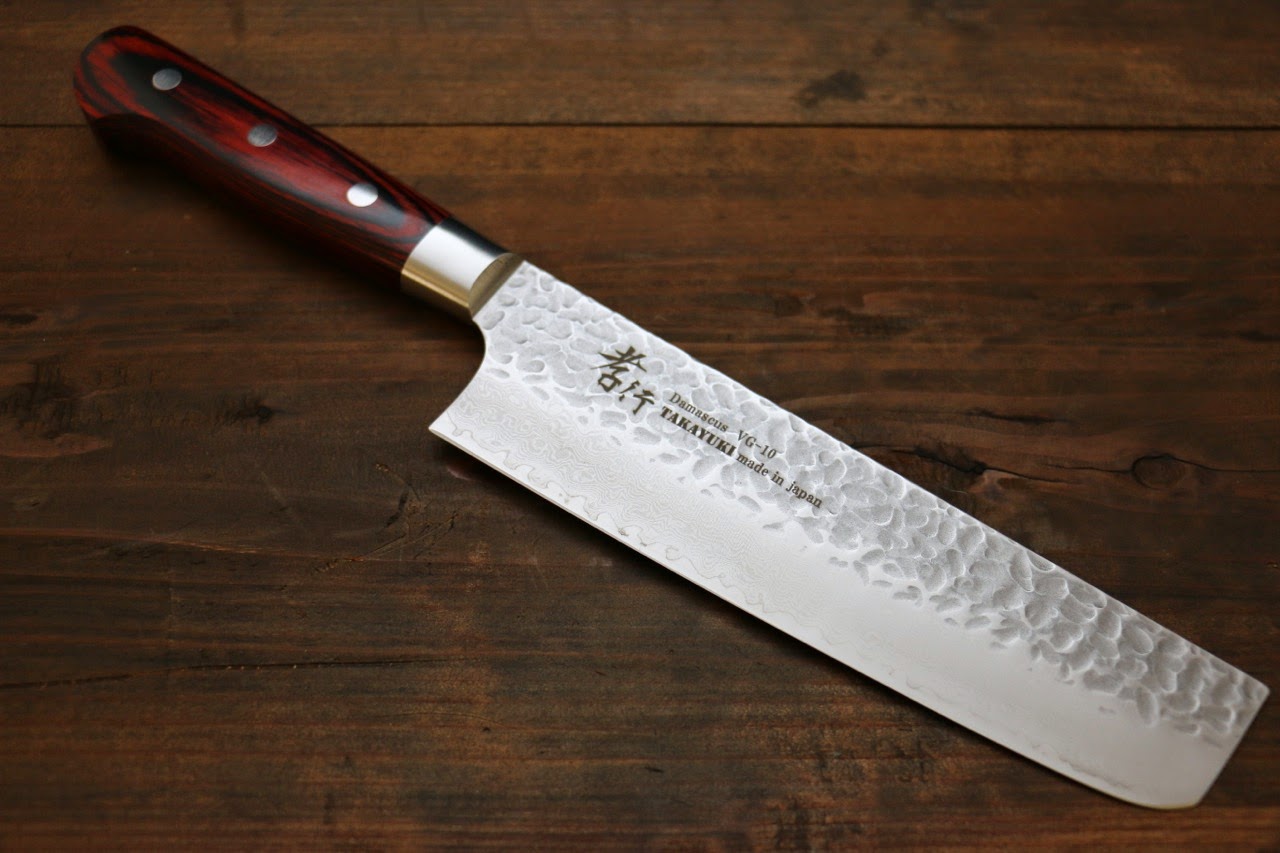
At japanny.com, we offer Sakai Takayuki VG10. It is a 33 layer folded Damascus steel vegetable knife. It has a double-edged blade length of 160mm and is stain-resistant.